
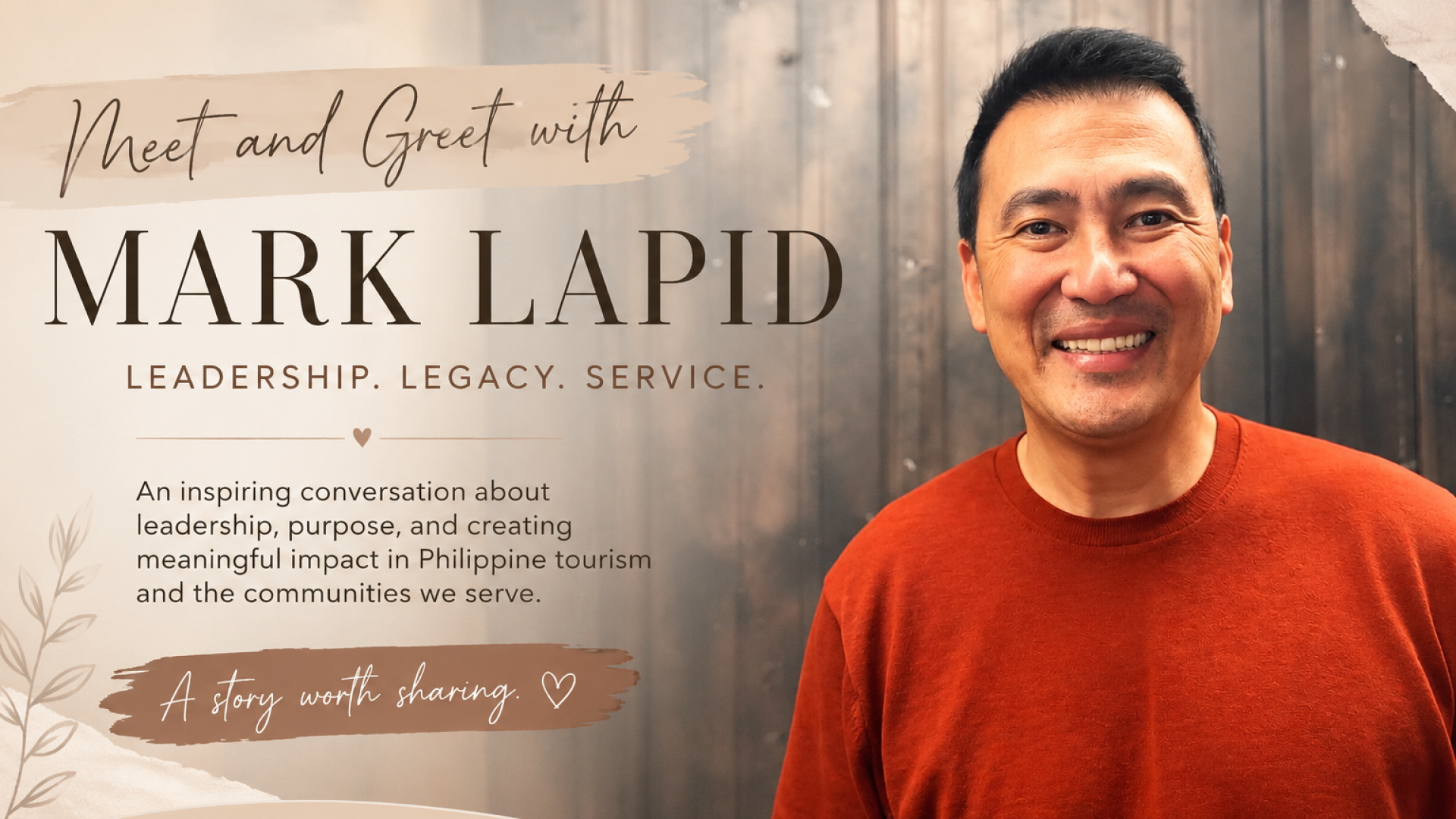






It’s not every day you get to meet someone who’s quietly shaping the future of Philippine tourism. We recently had the chance to attend a meet-and-greet with Mark Lapid, and it turned out to be more than just a quick hello—it was an insightful and refreshing conversation about leadership, service, and purpose.
Having served multiple terms as Chief Operating Officer of the Tourism Infrastructure and Enterprise Zone Authority (TIEZA), Mark Lapid continues to play a vital role in strengthening the Philippines’ tourism landscape. TIEZA, the infrastructure arm of the Department of Tourism, focuses on developing tourism enterprise zones and improving facilities that support the country’s growing travel industry.
Mark Lapid emphasized how tourism goes beyond travel and leisure. For him, it is a powerful driver of economic growth, capable of generating jobs and uplifting local communities. His work has consistently centered on improving tourism infrastructure, attracting investments, and ensuring that development reaches grassroots levels.
He highlighted the importance of building not just destinations, but experiences that benefit both tourists and the communities behind them—creating a more inclusive and resilient tourism ecosystem.

Mark Lapid discussed key updates regarding the operations and revenue sources of the organization, particularly focusing on travel tax collections and how these were affected during and after the pandemic period.
Main Source of Funding: Travel Tax
According to him, the main source of funding comes from travel tax collections. The structure of the allocation is as follows:
- A significant portion is allocated to the office operations
- 40% goes to CHED (Commission on Higher Education)
- 10% is allocated to NCCA (National Commission for Culture and the Arts)
This distribution supports both administrative functions and partner institutions involved in education and cultural development.
Impact of the Pandemic
During the COVID-19 pandemic, travel activity significantly decreased due to lockdowns and restrictions. As a result, travel tax collections also declined sharply, directly affecting available income for operations.
He explained that during this period, the organization could not rely on other revenue-generating facilities, including properties such as hotels, which were also affected by lockdown measures.
Because of this, operations had to be adjusted, including implementing work-from-home arrangements and recalibrating internal systems to continue functioning despite limited resources.
Recovery and Post-Pandemic Performance
Following the pandemic period, operations gradually recovered. By 2024, collection levels had returned to pre-pandemic figures, matching or surpassing those recorded in 2018–2019.
He noted that the organization has since regained stability and improved performance in terms of revenue collection.
Stronger Performance in 2025
For 2025, collections exceeded expectations, reaching over 1 billion, surpassing the figures recorded in 2019. This marks a significant recovery and improvement compared to the pre-pandemic baseline.
But beyond the titles and achievements, what truly resonated was the personal side of his story—one grounded in family and values.
Father and Son Relationship
Their relationship is described as a typical father-and-son bond, where the father serves as a personal model and source of inspiration. Mark Lapid has often expressed that he looks up to his father as a guiding figure in both life and service.
Despite differences in personality, communication style, and professional approach, there is a strong foundation of understanding between them. These differences are acknowledged as part of individual identity rather than a point of division.
Understanding Public Roles and Responsibilities
As a public figure, Lito Lapid’s work involves participation in formal government processes, including committee work and legislative responsibilities. These roles require engagement in structured discussions and institutional settings.
From a family perspective, these responsibilities are understood as part of the nature of political life. While not every aspect aligns with personal preference or strength, they are accepted as necessary components of public service.
Values Passed Within the Family
A central message within their family is the importance of recognizing what is needed in society and working toward addressing those needs. This value is shared among siblings and is reflected in their approach to service and personal development.
Education is emphasized as a key foundation in life. It is seen as something that cannot be taken away and serves as a long-term source of stability and empowerment. Material possessions may change or be lost, but education and moral values remain constant.
Education as a Personal Commitment
In 2024, Mark Lapid completed a doctoral degree at Pamantasan ng Lungsod ng Maynila. This achievement was described as a personal expression of gratitude and dedication to his father.
For the family, education represents more than academic achievement—it is viewed as a lasting investment in personal growth and service to others.
GMRC and Moral Development
Another important topic raised is the role of GMRC (Good Manners and Right Conduct) in education. There is a belief that moral values education should continue to be strengthened, as it plays a crucial role in shaping character and social responsibility.
While academic performance is important, moral conduct is seen as equally defining in assessing a person’s overall development. GMRC is viewed as a reflection of a person’s integrity and behavior in society.
Mark Lapid also emphasized the importance of documenting a life story while the person who lived it is still able to recall the details clearly and accurately.
He shared that the best time to record a personal history is while the individual is still mentally strong and capable of remembering key experiences. According to him, no one else can fully capture the depth of those moments except the person who actually lived them.
A Life of Hard Work and Humble Beginnings
He described his father’s early experiences, including working in various simple and physically demanding jobs. These included selling bread and ice, working in mountainous areas, farming, and taking care of horses. These experiences, he noted, form the foundation of a life story that deserves to be preserved in detail.
For him, these are not just memories, but important parts of a legacy that should be written down for future generations.
Preserving a Legacy Through Writing
Mark Lapid suggested that documenting the story could eventually lead to a book or film. He believes that while he may not be the one to complete such a project in his lifetime, it could be continued by the next generation of the family.
He acknowledged that time passes quickly and that future generations—possibly his children or relatives—may be the ones to bring the full story to life.
Challenges of Recreating Real Experiences
He also expressed that telling such a life story would require great effort and authenticity. Reenacting real experiences would involve physically demanding scenes such as farm work, riding horses, and other challenging environments.
Because of this, he stressed that whoever takes on the project must be fully prepared and willing to experience what the original person went through in order to portray the story accurately.
Family and Authentic Representation
Mark Lapid shared that, for their family, it is important that the story remains within those who truly understand its roots. He expressed that the representation of such a life should come from someone who respects and understands the family’s experiences.
Meeting Kuya Mark Lapid was a reminder that leadership isn’t always about being the loudest in the room, but about staying consistent, humble, and committed to making a difference. It left a lasting impression—one that speaks of purpose-driven service and a genuine desire to uplift communities through meaningful development.
In moments like this, you realize that behind every role and title is a story worth sharing—one that inspires hope and reminds us that real impact starts with vision, values, and heart.